Showing posts with label Trabaci. Show all posts

Sunday, 22 March 2020

Lachrimæ Caravaggio - Savall


There’s a record the presentation of which is not that simple, to say the least it’s extremely complicated. 
Why? It might turn out. 
Where should I start to make it clear avoiding sheer contemplation in art history? I can’t do it short and sweet, hardly in length either …

Well.
The following idea has several upbeats and interpretations; let’s start the question from afar.

What makes our fav records sound fine?
Surely, the loads of answers have one common point - the frequently referred ‘synergy’. When the pieces of equipment ‘love’ each other as well as the room they’re in and the music and our current state of our mind; when that certain feeling of unison is borne, which is pretty much the same as at a very good concert of living music in a church. This is very important especially with Early Music for it’s music of pure ideas and intense doctrine of harmonies. It’s an encoded, multilayer thing like multi-strata wines; we get something of the flavour at the first sip but the genuine entirety lightens up if we can place it into unity.


From this point on, however, this magical Unison has become much gappy by today; the churches have collapsed, the paintings have been scattered about, what’s left is hidden in museums; many private components have got lost, the world has undergone a vast change. We’re listening to this music, turning the pages of the booklet, trying to jailbreak the code or at least a fragment of it.
Wonderful attempts exist to musically restore the lost harmonies; the really successful Early Music recordings practically do it precisely. One of them which tries to open a broader horizon than the ordinary is Lachrimae Caravaggio.


It’s rather a project as the record is not merely a CD but a lot more. The booklet abounds in Caravaggio reproes and relatively many texts on art history and music theory, which slowly reveals what all this is about.


It all started with an exhibition in Spain, more exactly in Catalonia, Barcelona where Caravaggio’s ‘great’ paintings were collected.


Caravaggio.
This painter genius who had an adventurous and tragic life - you should read about him - lived in a period when the music Savall is interested in bloomed indeed; I do not mean the Brandenburg Concertos of course….:) 
Savall is Catalonian, he must have several fav cafes in Barcelona so the context is clear.


The writer Dominique Fernandez selected seven Caravaggio paintings; this became the seven stanzias. He wrote mini studies to each of them and Savall ‘composed’ the music onto them also in a division of seven. Practically, Goethe’s frequently quoted presumption was taken literally, namely, “Basso continuo can be found in paintings just like in music”.

Therefore, the music is a contemporary play of Savall; it is contemporary yet remained in the system of Early Music, what’s more, it is in secret harmony with the paintings.
Even language uses the word ‘harmony’ which is a synonym of accordance anyway.


The beautiful [Hungarian] tongue of ours too drifted with time, i.e., ‘harmony’ isn’t the right word, we’d better say that we’re trying to understand that paintings and music are the same, they’re one, they’re not told apart in a way we’re dissembling them 500 years later. 
It’s all-world rather than a matrix of different contexts.

It’s the Unity of Existence itself. 
Do you remember? Like when we see and visualise face to face.
It’s fairly complex, isn’t it?


Well-known melodies too are coming up; is it not a Savall piece after all? Yes and not because he did the same method as the composers in the 1500s - he inserted contemporary fashionable melodies and structures. 
Which of them? For instance, here we have Kapsberger’s Passacaglia whose beauty is flowing in waves into us. 


We come across Rossi’s Lamento or Trabaci’s infamous piece, Consonance Stravagante which is like a nice collection of question marks with its dissonant fineness; it suits here quite well. The base melody from which Cantus Firmus was born determines the whole record; in [Hungarian] folk music we say that it’s the wonderful re-entrant, well, we don’t know who composed it -  must be Savall’s - but it is absolutely magnificent.


The story runs along the paintings, the frame is the Holy Scripture itself and the language is the music. He uses the same colours as Caravaggio; the thousands of hues of black are especially striking; the lower gamba-voices are extremely colour-blacks; this, in another dimension, sets the entire plot into motion; the piece lacks lyrics, which weaves these nonverbal arcs even tighter.


The summits are nice, the relentless return of Cantus Firmus gives a different rhythm, an inevitable sub-monotony which is fragmented by the nice and familiar melodies in vain; rather, their fragile mortality is perceived. 

The analogies are multi-layered, there’re loads of question marks, perhaps the answers are there; when listening to it for the first time there will be rather a sort of wandering …


The instrumentation is beautiful: violas, chordophones, lute and harp jointly, cembalo and percussion, those weird twisted wind instruments - a complete Early Music arsenal.


Before the Reconquista, in the golden years of the early Cordoba Kalifates a handy dyer could dye 50 sorts of black.
The 7th string of the violas - the 7 Stanzias - the 7 times 7 hues of black  - build the pack of presumed or real nexuses...


And there is some shocking honesty. 
No-one but Caravaggio dared to paint so dirty legs. He collected his models in the street - the faces of prostitutes and tramps or unschooled peasants at best watch us from the paintings of elevated themes. The light-shadow effects of the paintings broke away from the old schools; strangely, the predominance of his multicolour black radiate more and more brightness. After his early death no-one ever painted this way, not even similarly.


It’s Early Music and it’s not, it’s simple and it’s not, it’s contemporary and it’s not. 
It’s multicolour and multi-layered.
It’s far from easy. What’s more, the paintings show lots of drama - death, passing, tears - it is Lachrimea Caravaggio indeed. The common point is that all these do not happen in vain, we can immediately see and hear that there’s going to be elevation, ecstasy (more precisely Assumption), salvation and sacrifice. 
Complicated underlying content, intense metaphysics.

And some weird meditative drifting.


However, Savall wouldn’t moan about the fact that the System had fallen apart or the world had changed because he happens to mention that the CD technology was necessary to take the music to us in this way and, for instance, the fact that the quality of the Caravaggio reproes in the booklet was simply not accomplishable even some 25 years ago.
We might add that anyone making such a record wasn’t accomplishable either …

The reception of the record was almost exactly like this:


The profs seem unable to step out of their own nerdyness or see a bit bigger circles.
Many of us, however, who like it are keen.

How about you?

I’m somewhat fond of copied/downloaded records but it’s worth now to make an exception because of the paintings and the text so I recommend to obtain the original SACD. You should borrow it for at least a few days. 
If you can’t then because of computer-listening you’d better watch the paintings on screen.


The sound quality is the usual very good AliaVox sound; even on hi-res SACD edition; here we bump into the issue of Unity again; Savall and his company have respected the spirituality rather than the acoustics of the place from the beginnings; they frequented the place to make the recordings.


A nice cathedral, Château De Cardona, they’re sitting somewhere inside on old chairs with striped upholstery and they’re making the next record... or exactly this one maybe… they may have a break right now, Savall is just changing the G string of his viola da gamba Zanetti from 1550s; the trumpeter and the harpist are smoking at the window… they’re recalling the lunch - how delicious the sofregit was today - and they may recall the green eyes of the waitress too…


But deep inside, in their souls, this music and some special celeste black shine have been all around them as long as they’ve been making this recording.


Translated by Kenesei Andrea


*         *         *


__________________________
Thank you for the images.
1-2-3-4-5-6-7-8-9-10-11-12-13-14

Saturday, 27 May 2017

Clavichord in the South Wind - Javier Nuňez


A record arrived from the far away Lisbon sent by a friend in Portugal. The CD made a journey of 2700 kms and I felt myself a bit like Seafarer Sinbad at an exotic dinner where a never-seen speciality from Moluccas is served.


The title is Modo Italiano and here comes the twist: most composers are from Naples, and, on the other hand, there used to be a few musical centres in Italy - Venice, Ferrara and Firenze - which received musicians from each part of Europe so the Italian mode is a much more complex thing than we would expect.


Looking at the map we can see that Naples is in the south to such extent that the wind coming from Africa can be tasted in the air. This, arm-in-arm with constant sunshine and brightness fills the eyes and the soul with some weird blaze. Let us remember the 26 year-old genius when the unpacked solar cells in our room start to produce energy when his Stabat Mater begins.

Another factor is political-geographical: the Kingdom of Naples was a savoury bite for the Spanish, Italian and even the Hapsburg dynasties; the Spanish dominated most as Naples on the Italian peninsula was part of Spain.

All the above had such big influence on the musical life that a distinct division—Neapolitan School—was established and Neapolitan Music intervened in the further musical movements for centuries.


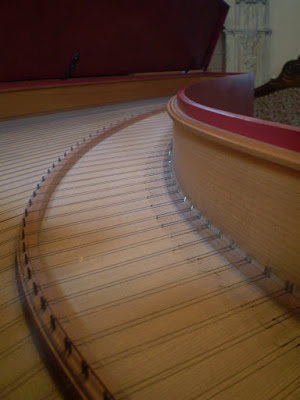
The clavichord is confined to being a simple continuo instrument; it ensures fine pace in operas or in orchestras. Why? Because its tone is basically distinct from other instruments, it hangs out thus it is well heard, the timpanist can listen to it and, being a string instrument, it gives the same volume no matter how hard it is hammered; there is no piano or forte.

Instead of lamentation let us look at the west where the music academies draw on ten times more in retrospect; the old keyboardists have a nice cult there. Strange it may seem but mention must be made of America, the USA having no culture which, despite the flood of commercial junk and trash gives home to such clavichord makers that we are out of breath by the delight.
The workshops in Europe and the Netherlands were the biggest sharks; jewel-like masterpieces were produced; however, today everyone plays on copies because the far-gone era means that the instruments cannot be tuned. The CD plays an Italian Giusti copy, the original was made in 1681.


Javier Nuňez studied at the Music Academy in Madrid and played a lot of Bach pieces I think; Goldberg variations are likely his favourite. However, he did not halt here but went on toward old things bypassing a big node in French baroque where Scarlatti/Couperin is the guiding mark. Nevertheless, the aim is Naples and Italy in the 1600s for the time being.

The period featured an extraordinary music life. Trabaci, Mayone, Valente, Macque and many others served as main choir masters, travelling music ambassadors or simple music teachers depending on their walk of life and fortune. On their way to the baker’s they might see Caravaggio... It was much honourable to perform any piece in front of the viceroy of Naples all over Europe. Naples meant an important visit or learning of a few years from a great master for each composer.


This portrait looks at us in the booklet. It is not a face of dozens. We create our picture of him browsing in the Internet and listening to the CD. It is a young new generation. prefers playing the composers of the past. There is something special in his playing compared to the older generation. Although he is not so young as ‘Z’s, the difference is a reality. Not better and not worse – another way only. 
He lacks etiquette posing, takes a seat, plays, because he loves playing. Indeed. He knows that these composers are well-known by those competent in music in Spain, the inner taste centre of the audience is papered with plenty of excellent records. However, he could reap much more with a Scarlatti record  but he does not care. I do believe it. He calls a few friends because he feels that some pieces might not have been played in solo, they should help with chordophones and rhythm. 
What next? 
He must announce “arranged” where the others joined but we feel that it is closer to reality than the rice powder game according to strict notes where the audience sits in tense fleeing to boredom and snobbism not understanding what the hell they should listen to in a monotonous and repetitive rhythm in which there is nothing to make out, there is no complicated Renaissance part leading or the delight of the fugue. 
However, the latter turns up in other numbers, e.g.,  Ascanio Mayone very much liked the counter-points but the emphasis is elsewhere because it was the age when the variation forms of dance, basso ostinato and free improvisation ask for entry to the music flow, it was the famous Nuovo Musiche.

Let us have a look.


As a start a very nice Antonio Valente fantasy; only accord lines first, then the idea starts winding along more and more complex arcs following an image of harmony. Then a Romanesca variation line, here Nuňez presents what he really thinks of it all; there are gaps in the tissue due to the differences of repetitions where we have a deep insight toward the infinity and all this freely rolling by flashing an entire freedom. This kind of boundlessness fully disappears from the later keyboard music; today’s ordinary audience brought up with sonatas and fugues doubts the existence of this inner vertical horizon; they find delight in something else, I am afraid that the Compass is not written for them because it must be felt - otherwise words only put out their tongue to us…


Some kind of central point can be presumed on a lot of CDs around which the whole album can be built up in our imagination and track 7 is outstanding on many CDs for some inexplicable numerological reason. It is no different here either, what is more, the two coincides.

Trabaci: Consonance Stravagante


Listening to it two things are heavily perceivable at the same time: on the one hand amazement, the chromatic dissonance alarms our sense of harmony in the segment of a second, on the other hand, the flood of delight. The more times we listen to it, the deeper it penetrates. Most Early Music performers noticed this weirdness and some of them commemorated the creep on their back with records 20 years ago. 


It is played on a solo clavichord nicely, straight and explicitly, taking on the singularity of the scale by members and black keys. Bear in mind that there were distinct tractates about the application of dissonance; I hope you remember the music of Gaspar Sanz or later Froberger.


As an ardent fan of Frescobaldi I have double joy: the genial performance of a Capriccio, here Nuňez is like entering a secret patio and a flood of odour is rolling onto us and then we can hear who Frescobaldi learnt from, who his master was, where he drew the raw material from for the incomparable, weird harmony, yes, it is Luzzascho Luzzaschi.

And a lot of Trabaci, Valente, Salvatore, de Macque and Storace.
Mayone received one track, one single toccata which we could listen to twilight.


The final piece is the summary of free music: an extravagant Colascione plot, the doctrinarian audience was taken aback by it in 1993, it is the Kapsberger record of Lislevand ; it was said to be jazz, world music and crossover, stupidity flooded; it is 1st class Early Music - Nuňez continues the fine tradition… I am afraid it will not be part of the program  at several Academies even next year… perhaps later …. when we landed on the Moon…
Fahmi Alqhai, who is playing on a strange, long-necked colascione rather than a gamba, is the artistic leader of the project, he and Nuňez considered everything even why this record is needed: they made the same decision as Luis de Narvaez 500 years ago when he scribed between two vihuela tablets with scratchy letters, that is, who does not know this music should marvel at it, and who do know it should marvel even more.


The outcome?
I think it is fine.
What do you think?


Translated by Kenesei Andrea 


______________________
Thank you for the images.
1-2-3-4-5-6-7-8-9-10-11