The entire blog expounds one sole and relatively short period, namely the first third of the 17th century.
What is so important in this era onto which a complete collection of records can be construed?
Has Bach nearly fallen into oblivion in the Early Music horizon of record publishers?
This period is a sensitive transition between the Renaissance and the Baroque. Something is borne and something is terminated, is it? This is what the miracle lies about.
Truly, this is not the case; it is a lot more complicated.
A lot more.

It is a bit like when two layers grind along, generating all sorts of turbulence, making the passengers in the plane pale by weird split-offs of the flow and stream. Albeit there was some wind of an odd direction and temperature. New winds are blowing.
We have a nice [Hungarian] language, do we?
What’s more, it was not a mandatory evolutional step in society or music history as we learn it from academic books but it was a well-conceived and pre-planned action. It was a wanted manoeuvre in music philosophy.

All leads to Firenze where culture blossomed at in unimaginable heights. A society of the many was Camerata Bardi, actually a parlour with all kinds of performances in the evenings and occasionally. The members included philosophers, architects, painters, businessmen, historians, clerical leaders, politicians and their flatterers, and loads of musicians and composers.
Antique pieces of art were being re-discovered as in vogue during the Renaissance, but, take care, music-wise it is the very end of the Renaissance. It is clear that the boundaries of the periods are not clear at all.
The Camerata Bardi proclaimed that “the music of the era is fundamentally unsuitable to express human relations either upwards to Heaven or toward one another”.
Therefore, they created, in theory, the music that they called Nuove Musiche.

Slowly yet steadily we come to the record as it bears this title.
Indeed, the then fashionable Palestrina-type polyphony was suitable to express emotions only limitedly.
This novel music became the accompanied monody, a lot simpler thing than this repelling so-called vocation. Only one line remained of the parts, usually the topmost, and below it a bass accompaniment which always holds a mirror at a distance of a fine sound, it did become basso continuo. Thus the one single melody could faithfully follow the lyrics, practically, syllable by syllable, so the text became prima again just like in Hellenic times.
Do you remember? It was the aim of Camerata, indeed.

And it did get started, including the Opera as well, which punctually follows the principles laid down even today, after 400 years, and it hauled at least ¾ of the classical music repertoire of the following centuries. And many more things … for instance, In the House of the Rising Sun on guitar …

Among the theorist-composers Caccini had the greatest role. He, being a requested expert, created a precise tractate, he even touched upon the techniques of breathing.

The new music spread like wildfire working its way out of Italy; three opera houses were built in Venice in 15 years out of the void.
And the audience?
They simply got crazy. People flooded into the opera houses and they played music in small circles too, at home, following the new style.
Fantastic masterpieces were borne the time.
I love them so much.
When the strong metaphysics of the Renaissance still exists.
Maybe you know this story - it is good old evidence in the Early Music academies.

Rolf Lislevand knows it too, he even put it down in the booklet, not because he wanted to be included in Wikipedia but he wanted us to understand his story which he tells us in this album.
For Lislevand took a very brave turn pursuing a beautiful idea.
The brevity is as much to my liking as the record itself.
This is why this article is being written.
He asks me if we know similar stories from the near past.
We know one for sure.
The basics of today’s performing Early Music were established by a few thinkers, composers, music-theorists and musicians some 40 years ago in Europe. Do you remember the contemporary instruments, 415 mean tone, the old sources, the old depictions of instruments, the gut-strings, the tabulatures, the viola da gamba itself and who Harnoncourt was?

The Early Music academies set off in this direction. The 3rd generation is producing their records, and the new Early Music became such a big success that they must be the last active actors of the dying record industry.

In this record Lislevand does nothing but return to Camerata’s Firenze and play the composers clustering there in his way as we can hear it.
The eyebrows are lifted in astonishment - it is an adaption then, a bit better than the Classics in disco rhytm…
Well, nope.
Extreme ignorance which slowly breaks up at the Bach-grey clouds - is not an excuse for such a big mistake.
Well, the reception of the CD was a little bit mixed; understanding and outcasting…
ECM is a contemporary music publisher so it shows that it is not the cake of Baroque Highlights.

For Lislevand makes a really smart argument: Let us observe how it all started 40 years ago? Everyone basked in the sea of Romanticism and we had to struggle out of it step by step; the performances we are happy about today are merely the gradual face lifts of the old recitations one after the other.

The human mind is able to make comparisons only, we compare everything to everything. It simply does not work that in 1980, in the air smelling Mendelssohn we suddenly play Vivaldi like in 2015. He was not played like that indeed, so we should not go back to Firenze, a restart from 40 years ago is sufficient … it is another branching this way, which may be parallel with what is in vogue right now…

It is said that there is some inner voice in a few musicians who devote all their life to sound it.
Rolf and some jazz musician friends of his gathered together with this thought in mind to make the record on an autumn afternoon in Oslo.

All of them are practicing improvising blokes, and, here comes a branch of Harnoncourts’ tractate. For Pellegrini and Foscarini and later Gaspar Sanz did recommend improvisation even in the first phase of learning, then even more, all the time, whenever it was possible, and mainly during the performance.
Listening to the record I can see that there is no mock modesty here indeed. The flouncing of the improvisations in a bound form is amazing.
It touches me.

What is this form? For instance, toccata, long before Bach and Vivaldi were born, when it was not a structural enforced pressure but what the word truly means, touching, a definitely special word because it also means an extraordinary point in time, the moment when the hand touches the string, when silence becomes non-silence, when something steps out of non-existence.
And when the audience is touched inside.
Or Passacaglia which gives the structural frame of the whole record. What is it indeed?

It is the old Spanish theatrical accompaniment insert, perhaps we know it, but how come it is here, well, yes, you make the right guess, it comes from the New World, where the Mexican origin competes with the ancient culture remnants of the natives of Africa, well, it is just fine that this slave stuff beats up the dust on European blue-blood noble stages…
E-moll Passacaglia obviously changes to the song Con qué la Lavare, it cannot be anything else, for it is very much the same; I admit that it is strange for me too. What is weird is not the way it sounds but where I have put my ears so far, it hasn’t rung the bell until now, 7 cm between the two CDs on the shelf, what a big gap in our head, as if we were afraid to notice things, almost ridiculous…


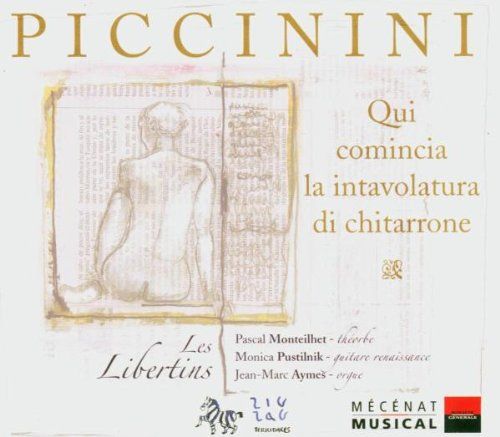
The modern forms of Kapsberger and Piccinini are being re-sequenced. What the toccata desires after being finished, they continue from that point.

Frescobaldi’s Aria is a response to the fact that it is poetry indeed that shows the right direction at the meeting point of the music and the lyrics.

And in Frescobaldi’s Passacaglia the last word is echoed, addio, Arianna’s soprano is very nice, it is a truly pretty farewell.

Owing to today’s authentic playing of Early Music.
Or due to our prejudices?
Or simply because of our very kind record at this moment around midnight?
Heiligenblut, 2017, August
at 1200 m AMSL
at 1200 m AMSL
Translated by Kenesei Andrea
___________________
Thank you for the images.